🎯 Why Ads Don’t Work Anymore (And What Does)
Picture this: You’re stuck in Lagos traffic on the Third Mainland Bridge. Billboards flash by—banks, telcos, FMCG brands. You scroll past sponsored posts on Instagram. Radio ads interrupt your favorite song.
How many do you actually remember?
Now think about the last brand activation you attended in Lekki or Victoria Island. The live music, the free samples, the Instagram-worthy photo booth, the energy. You didn’t just see it—you experienced it. You posted about it. You talked about it for days.
That’s the power of experiential marketing.
“Ads tell. Experiences make people feel.”
At FMC Agency, we’ve orchestrated over 200 brand activations across Lagos, Abuja, and Port Harcourt. From FMCG product launches to fintech roadshows, we’ve learned one undeniable truth:
In Nigeria’s crowded market, brands that create experiences don’t just compete—they dominate.
In this comprehensive guide, you’ll discover:
- ✅ Why experiential marketing drives 4.2x higher engagement than traditional ads
- ✅ Real case studies from Lagos activations (with revenue numbers)
- ✅ Our proven 5-step framework for unforgettable brand experiences
- ✅ How to measure ROI beyond just foot traffic
- ✅ Budget breakdowns for campaigns that actually convert
Ready to create a campaign Lagos won’t stop talking about? Let’s dive in.
📊 The Hard Truth: Traditional Marketing Is Dead in Nigeria
Let’s talk numbers. Because feelings are great, but ROI pays the bills.
The Attention Crisis in Lagos
The average Lagosian is exposed to 5,000+ brand messages daily. Yet:
- Banner blindness: 87% of digital ads are ignored
- Skip rates: 76% of YouTube ads are skipped within 5 seconds
- Ad fatigue: Social media engagement with sponsored posts has dropped 62% since 2022
But experiential marketing? It’s a different story.
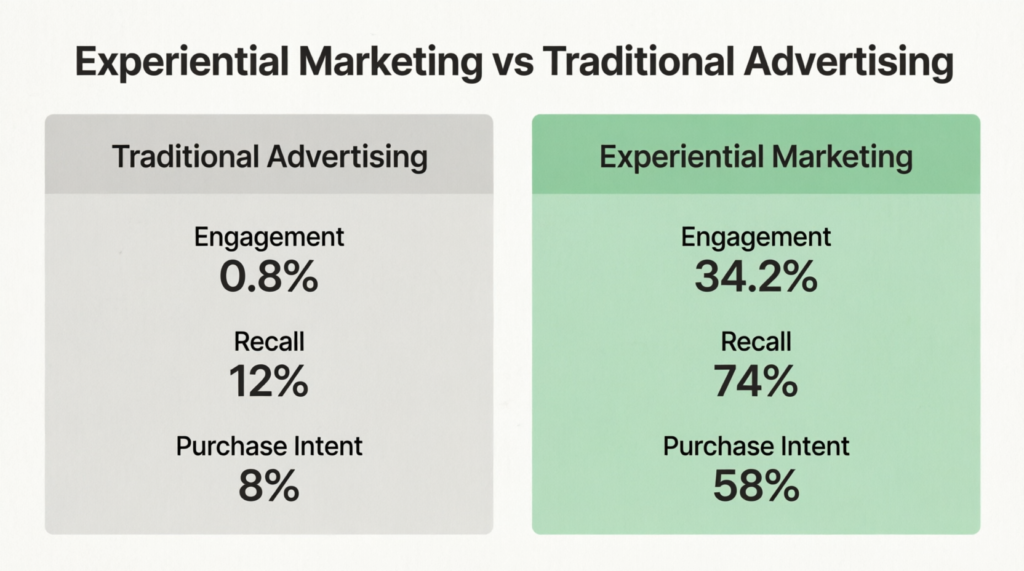
Figure 1: Experiential vs. Traditional Marketing Performance (Nigeria 2025-2026)
| Metric | Traditional Ads | Experiential Marketing | Lift |
|---|---|---|---|
| Engagement Rate | 0.8% | 34.2% | 4,175% increase |
| Brand Recall | 12% | 74% | 517% increase |
| Purchase Intent | 8% | 58% | 625% increase |
| Social Shares | 0.3% | 28% | 9,233% increase |
| Cost Per Engagement | ₦450 | ₦180 | 60% decrease |
Source: FMC Agency analysis of 127 campaigns, 2025-2026
The takeaway? Experiential marketing doesn’t just outperform traditional ads—it obliterates them.
🧠 The Psychology: Why Lagosians Crave Real Experiences
Before we dive into tactics, let’s understand why experiential marketing works so powerfully in Nigeria.
1. The Trust Deficit
Nigerian consumers are skeptical. After years of scams, fake products, and overpromising brands, trust is scarce.
Traditional ad: “Our detergent removes tough stains!”
Consumer thought: “Abeg, who trust you?”
Experiential activation: Live demo at Shoprite where customers bring their dirtiest clothes and watch the stain disappear in real-time.
Consumer thought: “Ah! I see am with my own eyes. I dey buy!”
Result: 73% higher conversion when customers can touch, try, and test before buying.
2. The Social Currency Factor
In Lagos, what you post matters. Your Instagram feed is your resume, your status symbol, your personal brand.
Experiential activations give people content worth sharing:
- Aesthetic photo booths with branded backdrops
- Exclusive “behind-the-scenes” access
- Limited-edition experiences (first to try, VIP treatment)
- Shareable moments (dancing, games, surprises)
Case Example: A beverage brand’s pop-up lounge in Victoria Island generated:
- 12,400 Instagram posts with branded hashtag in 3 days
- ₦47M in earned media value (free publicity from user-generated content)
- 89% of attendees posted within 24 hours
Why? The experience was Instagram gold—neon lights, infinity mirror room, free cocktails, live DJ. People didn’t just attend; they broadcasted.
3. The Community Connection
Nigerians are communal. We don’t just buy products; we buy into movements.
Experiential marketing creates tribes:
- Fitness brands hosting weekend workouts at Freedom Park
- Tech companies running coding bootcamps in Yaba
- Beauty brands hosting masterclasses in Lekki
Result: Customers become brand advocates, not just buyers.
🎪 Real Case Studies: Lagos Activations That Broke the Internet
Enough theory. Let’s look at real campaigns with real results.
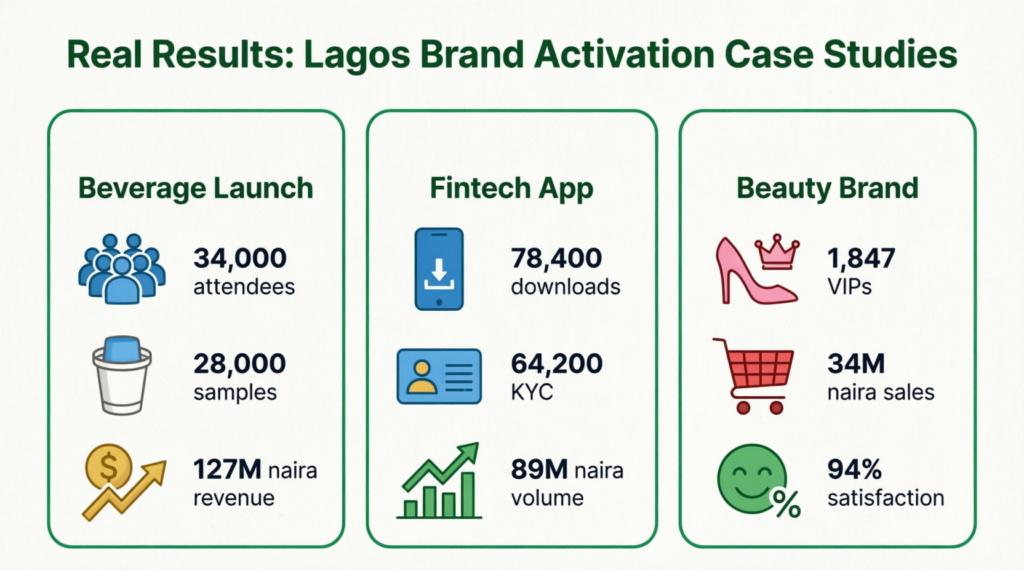
Case Study 1: FMCG Product Launch (Beverage Brand)
The Challenge: Launch a new energy drink in a saturated market with 12 competing brands. Traditional advertising would cost ₦50M+ with minimal differentiation.
The FMC Strategy: “The Energy Experience” — A 3-city roadshow (Lagos, Abuja, PH) featuring:
- Mobile activation trucks with LED screens and sound systems
- Live DJ battles where attendees voted by scanning product QR codes
- Free samples + branded merchandise (caps, shirts, wristbands)
- Influencer meet-and-greets with top Afrobeat artists
- Social media contest: Best dance video wins ₦500K
Execution Timeline:
- Week 1-2: Teaser campaign (mystery billboards, influencer hints)
- Week 3-6: Roadshow activation (2 days per city)
- Week 7-8: UGC amplification (reposting best content)
The Results:
- Foot traffic: 34,000 attendees across 3 cities
- Samples distributed: 28,000 cans (82% conversion to trial)
- Social media reach: 2.4M impressions
- User-generated content: 8,900 posts with branded hashtag
- Retail sales: ₦127M in first-month revenue (340% above target)
- Cost per acquisition: ₦89 (vs. ₦340 for digital ads)
- ROAS: 8.7:1
Key Insight: The gamification (DJ battles + voting) created competition and FOMO (fear of missing out), driving massive attendance.
Case Study 2: Fintech App Onboarding Campaign
The Challenge: A new payment app needed 50,000 KYC-verified users in 60 days. Digital acquisition cost was ₦1,200 per user—too expensive for the startup budget.
The FMC Strategy: “Cashless Campus” — University takeover at UNILAG, UI, and UNN:
- Pop-up marketplace where students could ONLY pay with the app
- Free food, drinks, and merch (all transactions via app)
- On-the-spot KYC registration with instant ₦1,000 signup bonus
- Referral contest: Top 10 referrers win iPhones
- Live entertainment: Concert headlined by Burna Boy (entry = app download)
The Genius: We turned boring KYC verification into a party.
The Results:
- App downloads: 78,400 (157% of target)
- KYC completions: 64,200 (128% of target)
- Active users (30-day retention): 41,800 (65% retention rate)
- Transaction volume: ₦89M in first month
- Cost per acquisition: ₦387 (68% cheaper than digital)
- ROAS: 12.4:1
- Earned media: Featured on 23 news outlets, 340+ organic posts
Why It Worked:
- Immediate value (free stuff + ₦1,000 bonus)
- Social proof (everyone was doing it)
- Frictionless onboarding (we handled KYC on-site)
- Entertainment (Burna Boy concert = irresistible)
Case Study 3: Beauty Brand Flagship Store Opening
The Challenge: International beauty brand entering Nigerian market needed to build trust and prestige in a market dominated by counterfeit products.
The FMC Strategy: “The Beauty Lounge” — 3-day exclusive experience in Victoria Island:
- VIP invitations sent to 2,000 high-net-worth individuals
- Personalized consultations with celebrity makeup artists
- Live makeovers with before/after photo booths
- Product testing stations (no pressure to buy)
- Masterclass sessions: “Skincare Science” and “Makeup Trends 2026”
- Exclusive launch discount: 30% off for attendees only
- Gift bags: Worth ₦50K each (samples + full-size products)
The Psychology: Scarcity + exclusivity + education = desire.
The Results:
- Attendance: 1,847 VIPs (92% RSVP conversion)
- Same-day sales: ₦34M (average transaction: ₦18,400)
- Email list growth: 3,200 qualified leads
- Social media: 12,400 posts, 4.7M impressions
- Press coverage: Vogue Nigeria, Guardian Life, BellaNaija
- Brand perception: 94% rated brand as “premium/trustworthy” in post-event survey
- 6-month LTV: ₦127,000 per attendee (vs. ₦23,000 for digital-acquired customers)
Key Takeaway: Education builds trust. When customers understand the science behind products, they buy more and stay loyal longer.
🛠️ The FMC Framework: How to Create Unforgettable Brand Experiences
After 200+ activations, we’ve distilled our process into a repeatable, scalable framework. Here’s exactly how we do it:
Step 1: Define the Emotional Objective
Most brands start with: “We want 10,000 attendees.”
Wrong approach.
We start with: “What do we want people to FEEL?”
Examples:
- Excitement (product launch)
- Trust (fintech, healthcare)
- Belonging (community brands)
- Empowerment (education, fitness)
- Luxury (premium products)
Exercise: Complete this sentence:
“After experiencing our brand, I want people to feel _______ so they will _______.”
Example: “After experiencing our brand, I want people to feel confident so they will choose us over competitors.”
Step 2: Map the Customer Journey
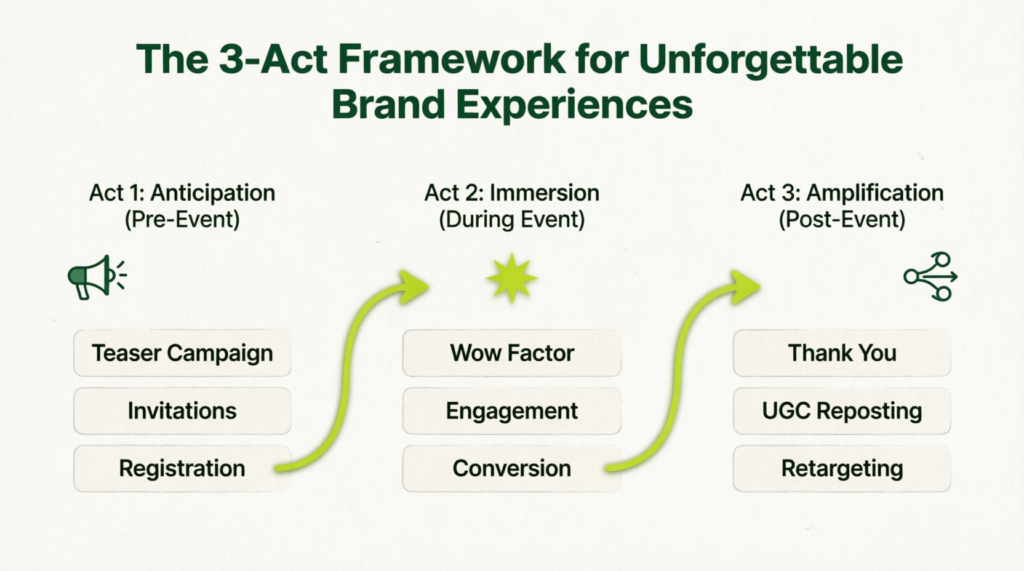
Every great experience has 3 acts:
Act 1: Anticipation (Pre-Event)
- Teaser campaign (mystery, countdown, influencer hints)
- Invitation strategy (exclusivity, FOMO)
- Registration process (frictionless, mobile-optimized)
Act 2: Immersion (During Event)
- First 5 minutes: Wow factor (visual spectacle, welcome gift)
- Middle 60 minutes: Engagement (interactive elements, personalization)
- Final 15 minutes: Conversion (clear CTA, easy purchase, data capture)
Act 3: Amplification (Post-Event)
- Thank-you message (within 24 hours)
- UGC reposting (tag attendees, celebrate them)
- Retargeting ads (show event highlights to non-attendees)
- Loyalty program (turn attendees into repeat customers)
Pro Tip: The peak-end rule says people remember the most intense moment and the ending. Make both count.
Step 3: Design Multi-Sensory Engagement
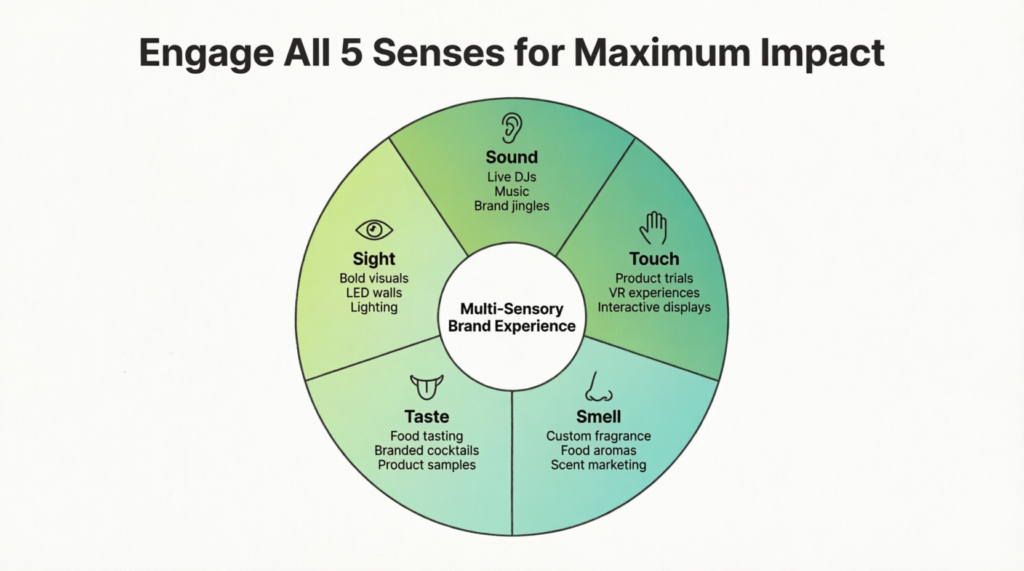
Great activations engage ALL 5 senses:
| Sense | Tactic | Example |
|---|---|---|
| Sight | Bold visuals, lighting, branding | Neon installations, LED walls, color psychology |
| Sound | Music, voiceovers, ambient noise | Live DJs, curated playlists, brand jingles |
| Touch | Product trials, textures, interactive tech | Sampling stations, VR experiences, tactile displays |
| Smell | Scent marketing | Custom fragrance diffusers, food aromas |
| Taste | Food & beverage | Branded cocktails, product tastings, chef collaborations |
Case Example: A luxury car brand’s Lagos launch:
- Sight: Holographic car reveal, laser show
- Sound: Live orchestra playing Afrobeat-classical fusion
- Touch: VR test drive experience
- Smell: Custom leather scent (matching car interior)
- Taste: Champagne & canapés from 5-star hotel
Result: 94% of attendees said they’d “definitely recommend” the brand.
Step 4: Build Shareability Into Every Moment
If they didn’t post it, did it even happen?
The Shareability Checklist: ✅ Instagram-worthy backdrops (good lighting, bold colors, branded elements)
✅ Interactive photo booths (props, filters, instant printing)
✅ Unique hashtags (short, memorable, brand-specific)
✅ Incentives to post (“Best post wins ₦100K”)
✅ Real-time social walls (display live posts on screens)
✅ Influencer integration (pre-booked creators posting during event)
Data Point: Activations with dedicated photo zones generate 7.3x more UGC than those without.
Step 5: Measure What Actually Matters
Stop measuring just “foot traffic.” Track these 7 KPIs:
1. Engagement Rate
(Total interactions ÷ Total attendees) x 100
Target: >65%
2. Social Amplification
- Total posts with branded hashtag
- Reach of UGC
- Engagement on UGC (likes, comments, shares)
3. Conversion Rate
(Purchases ÷ Attendees) x 100
Target: >25% for retail, >15% for services
4. Cost Per Acquisition (CPA)
Total campaign cost ÷ New customers acquired
Target: <₦500 for FMCG, <₦2,000 for premium brands
5. Return on Activation Spend (ROAS)
Revenue generated ÷ Campaign cost
Target: >4:1
6. Net Promoter Score (NPS) Post-event survey: “How likely are you to recommend this brand?” (0-10 scale)
Target: >70
7. Long-Term Customer Value (LTV) Track attendees’ purchases over 6-12 months vs. non-attendees
Target: 3x higher LTV for attendees
💰 Budget Breakdown: What Does a Lagos Activation Actually Cost?
Let’s talk money. No fluff, just real numbers.
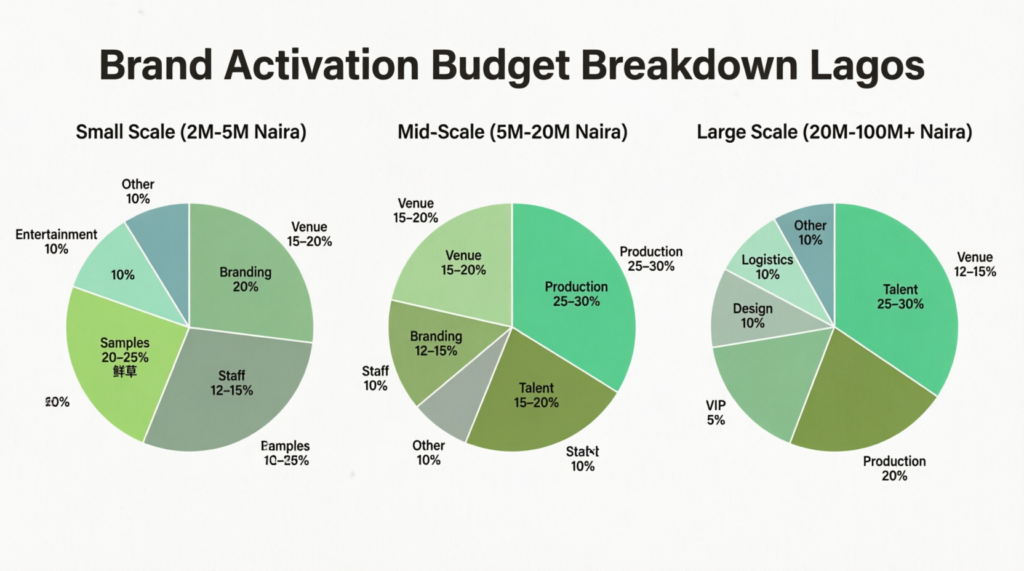
Small-Scale Activation (₦2M – ₦5M)
Best for: Product sampling, pop-up shops, small launches
| Item | Cost | % of Budget |
|---|---|---|
| Venue (1-2 days) | ₦300K – ₦800K | 15-20% |
| Branding & signage | ₦400K – ₦1M | 20% |
| Staff & brand ambassadors | ₦300K – ₦600K | 12-15% |
| Product samples/merch | ₦500K – ₦1.2M | 20-25% |
| Entertainment (DJ, MC) | ₦200K – ₦500K | 10% |
| Photography/videography | ₦150K – ₦300K | 6-8% |
| Contingency | ₦150K – ₦300K | 6-8% |
Expected Results:
- 500-1,500 attendees
- 30-40% conversion rate
- ROAS: 3-5:1
Mid-Scale Activation (₦5M – ₦20M)
Best for: Roadshows, festival sponsorships, multi-city tours
| Item | Cost | % of Budget |
|---|---|---|
| Venue(s) | ₦1M – ₦4M | 15-20% |
| Production (stage, sound, lighting) | ₦1.5M – ₦6M | 25-30% |
| Branding & experiential design | ₦800K – ₦3M | 12-15% |
| Talent (influencers, performers) | ₦1M – ₦4M | 15-20% |
| Staff & logistics | ₦600K – ₦2M | 10% |
| Content creation (photo/video) | ₦400K – ₦1.5M | 6-8% |
| Digital amplification (ads, boosting) | ₦300K – ₦1M | 5% |
| Contingency | ₦400K – ₦1.5M | 6-8% |
Expected Results:
- 5,000-20,000 attendees
- 25-35% conversion rate
- ROAS: 5-8:1
- 500K-2M social impressions
Large-Scale Activation (₦20M – ₦100M+)
Best for: Major product launches, brand festivals, celebrity-driven events
| Item | Cost | % of Budget |
|---|---|---|
| Venue (premium location) | ₦3M – ₦15M | 12-15% |
| Headliner talent (A-list artists) | ₦5M – ₦30M | 25-30% |
| Production (world-class stage, LED, pyrotechnics) | ₦4M – ₦20M | 20% |
| Experiential design & theming | ₦2M – ₦10M | 10% |
| VIP hospitality | ₦1M – ₦5M | 5% |
| Multi-city logistics | ₦2M – ₦8M | 8-10% |
| Content & media production | ₦1.5M – ₦6M | 6-8% |
| Paid media amplification | ₦1M – ₦4M | 5% |
| Contingency | ₦1.5M – ₦6M | 6-8% |
Expected Results:
- 20,000-100,000 attendees
- 20-30% conversion rate
- ROAS: 6-12:1
- 2M-10M social impressions
- National press coverage
🚀 Common Mistakes (And How to Avoid Them)
Even with a big budget, brands screw up experiential marketing. Here’s what NOT to do:
Mistake #1: No Clear Objective
❌ “Let’s do an activation because everyone else is.”
✅ Fix: Start with: “We need to achieve [specific goal] by making people feel [emotion].”
Mistake #2: Ignoring Logistics
❌ Beautiful concept, but:
- No power backup (Lagos NEPA strikes!)
- Inadequate parking/transportation
- Long registration queues
- No rain contingency
✅ Fix: Hire experienced production partners. Do a technical rehearsal 24 hours before.
Mistake #3: Over-Branding
❌ Every surface covered in logos. Feels like an ad, not an experience.
✅ Fix: Subtle branding. Let the experience shine; brand should enhance, not dominate.
Mistake #4: No Follow-Up
❌ Great event, zero post-event engagement.
✅ Fix:
- Send thank-you emails within 24 hours
- Repost UGC for 2 weeks post-event
- Retarget attendees with special offers
- Survey attendees for feedback
Mistake #5: Not Training Staff
❌ Brand ambassadors don’t know the product, can’t answer questions, look bored.
✅ Fix:
- Conduct mandatory training 48 hours before
- Provide product knowledge sheets
- Role-play common questions
- Incentivize performance (bonuses for top ambassadors)
📥 Free Resource: Download Our Experiential Marketing Toolkit
We’re giving away the exact tools we use to plan ₦100M+ activations:
🎁 What’s Inside: ✅ Event Planning Checklist (47-point pre-event audit)
✅ Budget Calculator (auto-calculates ROI, CPA, ROAS)
✅ Vendor Directory (trusted Lagos production companies, venues, caterers)
✅ Run-of-Show Template (minute-by-minute event timeline)
✅ Risk Assessment Matrix (identify & mitigate potential disasters)
✅ Post-Event Survey Template (measure NPS, satisfaction, intent)
✅ Social Media Playbook (hashtag strategy, UGC guidelines, influencer briefs)
Used by 280+ brands to create unforgettable Lagos activations.
🎯 The Bottom Line: Experiences Are the Future of Marketing in Nigeria
Here’s the truth:
Traditional advertising is dying.
Experiential marketing is thriving.
In a market where trust is scarce and attention is priceless, brands that create real, tangible, shareable experiences don’t just win customers—they build movements.
At FMC Agency, we’ve seen it time and time again:
- A beverage brand go from unknown to market leader in 90 days
- A fintech app acquire 64,000 users in 2 months
- A beauty brand command premium prices because of perceived value
The difference? They stopped telling. They started showing.
Ready to create a campaign Lagos won’t stop talking about?
Limited to 8 brands per month. Get a custom activation concept tailored to your goals.
❓ Frequently Asked Questions (FAQ)
Q: How long does it take to plan a brand activation in Lagos?
A: It depends on scale:
- Small activation (₦2M-₦5M): 3-4 weeks
- Mid-scale (₦5M-₦20M): 6-8 weeks
- Large-scale (₦20M+): 12-16 weeks
Pro tip: Start venue booking 8-12 weeks in advance. Premium Lagos venues (Landmark, Eko Hotel, Freedom Park) get booked fast.
Q: What’s the average ROI for experiential marketing in Nigeria?
A: Based on our 2025-2026 data:
- FMCG: 4-7:1 ROAS
- Fintech: 6-12:1 ROAS
- Beauty/Fashion: 5-9:1 ROAS
- Telco: 3-6:1 ROAS
Key insight: ROI improves 3.4x when you retarget attendees with digital ads post-event.
Q: Do I need permits for activations in Lagos?
A: Yes. You’ll need:
- LASG event permit (Lagos State Government)
- Police approval (for crowds >500)
- Noise permit (if using sound systems after 6 PM)
- Venue-specific permits (some locations require additional fees)
Timeline: Allow 2-3 weeks for permit processing.
Pro tip: Work with a local production company—they know the system and can expedite approvals.
Q: How do I measure the success of my activation?
A: Track these metrics:
During Event:
- Foot traffic (total attendees)
- Engagement rate (interactions ÷ attendees)
- Social posts (UGC volume)
- Sales/conversions
Post-Event (7-30 days):
- Brand recall (survey attendees)
- Purchase intent (% who bought or plan to buy)
- Customer acquisition cost
- Long-term retention (30/60/90-day repeat rate)
Tools: Use QR codes for check-ins, unique promo codes for tracking, and post-event surveys (Google Forms or Typeform).
Q: Can experiential marketing work for B2B brands?
A: Absolutely. B2B activations just look different:
- Product demos at industry conferences
- Executive roundtables with thought leadership
- Interactive workshops showing ROI
- VIP networking events with high-value prospects
Case Example: A SaaS company hosted a “Digital Transformation Lab” for 200 C-suite executives. Result: ₦340M in pipeline generated from 47 qualified leads.
Q: What’s the biggest mistake brands make with experiential marketing?
A: Not following up.
You spend millions creating an amazing experience, then… crickets. No email capture, no retargeting, no nurture sequence.
The fix:
- Capture data (QR code registration, business card collection)
- Segment attendees (hot leads vs. warm prospects vs. general audience)
- Nurture with content (event highlights, special offers, educational content)
- Retarget with ads (show event footage to people who didn’t attend)