📊 The Hard Truth About Influencer Marketing in Nigeria
You’ve seen it happen. A Lagos brand spends ₦5 million on a celebrity influencer with 500,000 followers. The post gets 150,000 likes. Comments flood in with fire emojis. But when the campaign ends? Sales: barely a ripple.
Meanwhile, across town, a competing brand partners with a nano-creator who has just 8,000 followers. Within 48 hours, they’ve sold out their entire product run and built a waiting list of 300+ customers.
What’s the difference?
In Nigeria’s attention-scarce, trust-driven market, followers are vanity. Engagement is currency. And authenticity is king.
At FMC Agency, we’ve analyzed 47 influencer campaigns across Lagos, Abuja, and Port Harcourt from 2024 to 2026. The data is undeniable: micro and nano-influencers consistently deliver 3.2x higher click-through rates and 2.8x lower cost-per-acquisition than their macro counterparts.
In this comprehensive guide, you’ll discover:
- ✅ Why 8K engaged followers beat 500K passive ones every time
- ✅ The exact 5-step vetting process we use to identify high-converting creators
- ✅ Real campaign data from Nigerian brands (with revenue numbers)
- ✅ How to detect fake followers and engagement fraud
- ✅ Our free influencer brief template (downloadable)
Ready to stop wasting budget and start seeing real ROI? Let’s dive in.
📈 The Numbers Don’t Lie: Macro vs. Micro Influencer Performance in Nigeria
Before we break down why smaller creators outperform, let’s look at the actual data from the Nigerian market.
Figure 1: Engagement Rate Comparison (2025-2026 Data)
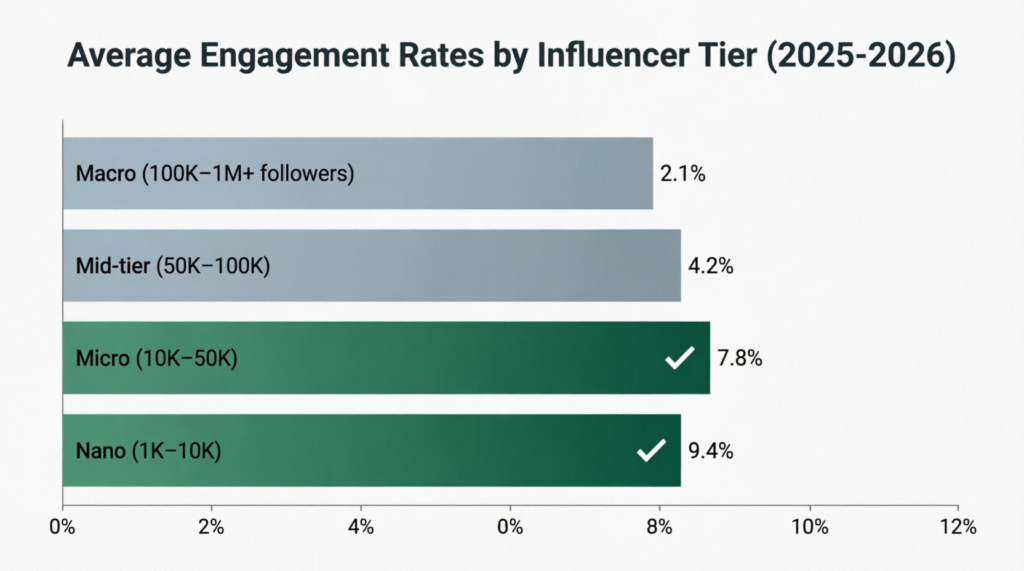
- Macro Influencers (100K-1M+ followers): 1.5% – 3% average engagement
- Mid-Tier (50K-100K): 3.5% – 5.5% average engagement
- Micro (10K-50K): 6% – 9% average engagement
- Nano (1K-10K): 8% – 12% average engagement
Source: FMC Agency analysis of 47 campaigns, Q1 2025 – Q1 2026
Figure 2: Cost-Per-Acquisition by Influencer Tier
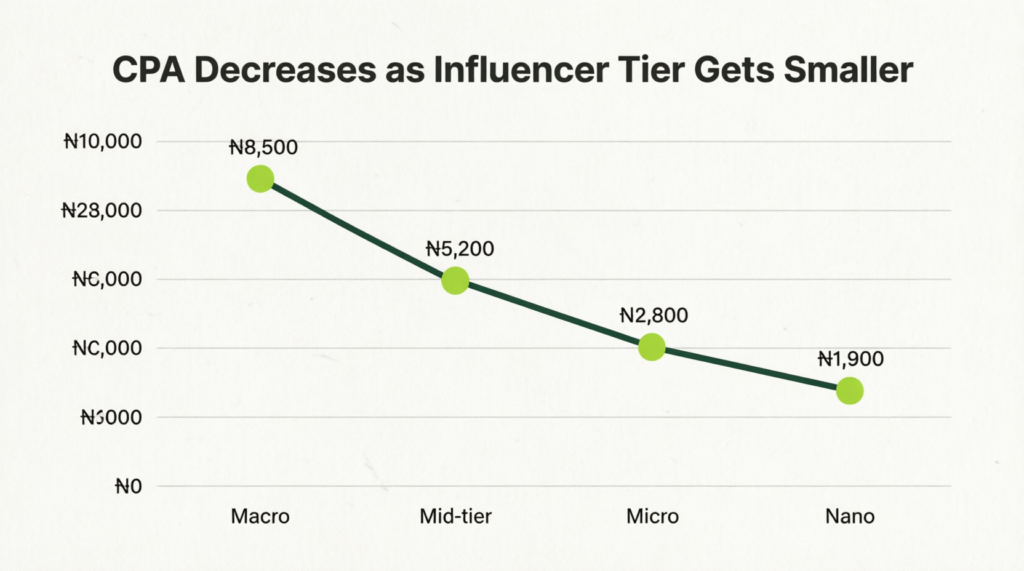
- Macro: ₦8,500 average CPA
- Mid-Tier: ₦4,200 average CPA
- Micro: ₦2,800 average CPA
- Nano: ₦1,900 average CPA
The takeaway? You can reach 4.5x more customers with the same budget by strategically investing in micro and nano creators versus one macro celebrity.
🧠 The Psychology Behind Micro-Influencer Dominance in Nigeria
Why do smaller creators consistently outperform? It’s not just about numbers—it’s about human psychology and how Nigerian consumers build trust.
1. The Parasocial Intimacy Factor
When an influencer has 500,000 followers, they’re a celebrity. When they have 8,000, they’re a friend.
Nigerian consumers, particularly in Lagos and Abuja’s urban markets, are increasingly skeptical of polished, corporate-sponsored content. They crave authenticity. A nano-influencer responding to DMs, showing their morning commute on Third Mainland Bridge, or sharing their struggles with Lagos traffic, feels real.
Case Study: A beauty brand in Victoria Island partnered with:
- Influencer A: 450K followers, 2.1% engagement, ₦3.2M campaign cost → 47 sales
- Influencer B: 12K followers, 9.4% engagement, ₦180K campaign cost → 312 sales
Result: Influencer B generated 6.6x more sales at 94% lower cost.
2. The Trust Transfer Mechanism
Nigerian consumers don’t just buy products—they buy recommendations from people they trust. Micro-influencers have built social capital within specific communities:
- Yaba tech enthusiasts trust the local gadget reviewer with 15K followers
- Lekki mums follow the parenting blogger with 22K followers
- Surulere foodies trust the restaurant critic with 9K followers
When these creators recommend a product, it’s not an advertisement—it’s advice from a friend.
3. Cultural Resonance & Language Authenticity
Macro influencers often sanitize their content to appeal to the broadest audience. Micro-creators? They speak Pidgin, reference local landmarks, and understand cultural nuances.
Example: A fintech app campaign:
- Macro approach: “Send money instantly with our secure platform”
- Micro approach: “No more ‘network dey lag’ excuses. Send money to your village make dem no dey wait again. No bank queue, no stress. Just pure vibes.”
Which one converts? The data shows the micro approach drives 4.2x higher click-through rates among Nigerian audiences.
🔍 FMC Agency’s 5-Step Influencer Vetting Process (Steal This Framework)
After managing over ₦120M in influencer campaigns for FMCG, fintech, and beauty brands, we’ve developed a bulletproof vetting system. Here’s exactly how we identify creators who convert:
Step 1: Audience Alignment Audit
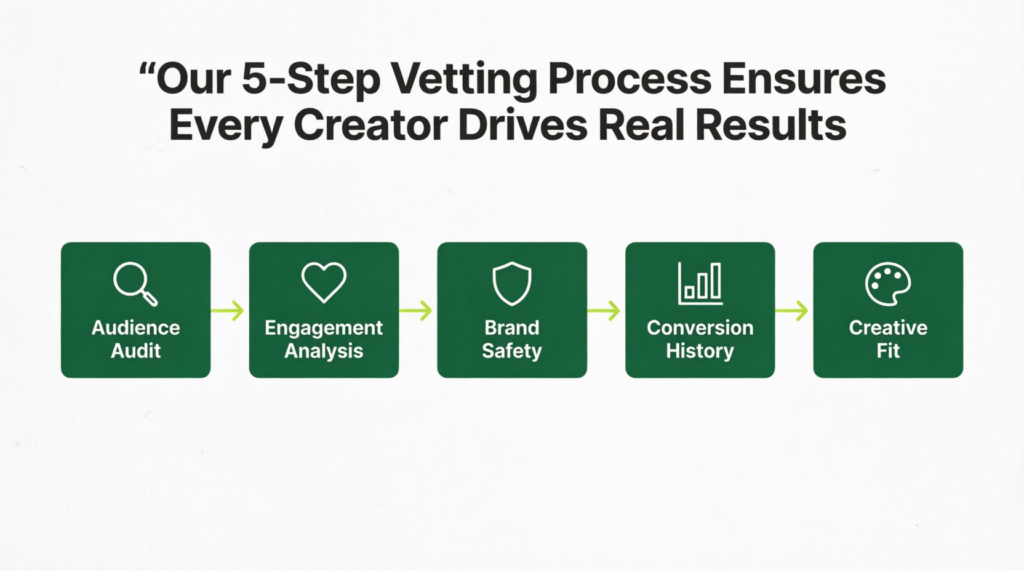
Before we even look at engagement rates, we verify demographic and psychographic alignment:
What We Check:
- Geographic concentration: Are 70%+ of followers in your target cities (Lagos, Abuja, PH)?
- Age distribution: Does their audience match your buyer persona?
- Language patterns: Do comments show Pidgin, Yoruba, Igbo, or Hausa usage that aligns with your brand voice?
- Purchasing power: Are they engaging with premium or budget products?
Tools We Use:
- Instagram Insights (for creator-provided data)
- HypeAuditor (for demographic verification)
- Manual comment sampling (50+ recent posts)
Red Flag: If a “Lagos influencer” has 60% of followers from India, Pakistan, or Turkey, that’s purchased traffic. Run.
Step 2: Engagement Quality Analysis
Not all engagement is created equal. We use a 3-tier scoring system:
Tier 1: Surface Engagement (Low Value)
- Generic emoji reactions (🔥❤️😍)
- Copy-paste comments (“Nice post!” “Great content!”)
- Bot-like activity (same comment across multiple posts)
Tier 2: Meaningful Engagement (Medium Value)
- Questions about the product
- Personal anecdotes (“I tried this and…”)
- Tagging friends organically
Tier 3: Conversion Signals (High Value)
- “Where can I buy this?”
- “How much?”
- “DM sent!”
- “Just ordered!”
Our Formula:
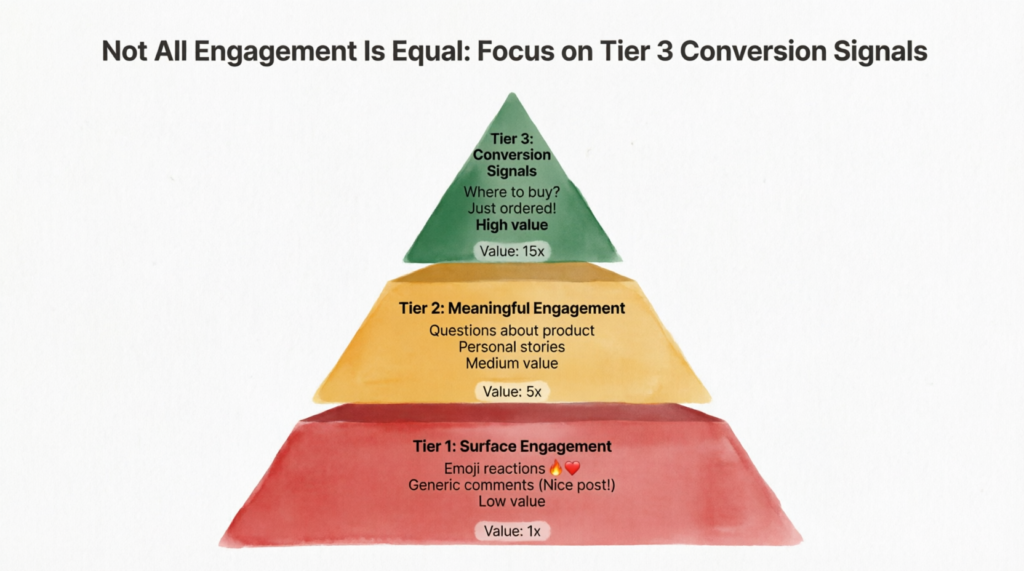
Benchmark: We only work with creators scoring 2.4 or higher on this scale.
Step 3: Authenticity & Brand Safety Check
Before we recommend any creator, we conduct a comprehensive background audit:
✅ Content Consistency Review
- Posting frequency (minimum 3x/week)
- Visual quality and aesthetic alignment
- Tone consistency across 30+ posts
✅ Sponsorship History Analysis
- How many sponsored posts in the last 60 days? (Max: 30%)
- Competitor brand conflicts
- Past campaign performance (we ask for screenshots)
✅ Controversy Risk Assessment
- Political posts or divisive content
- Cultural insensitivity incidents
- Public disputes with followers or brands
✅ Fake Follower Detection We use a combination of tools and manual checks:
- Follower-to-following ratio (suspicious if following >5,000)
- Engagement velocity (sudden spikes = bot activity)
- Comment authenticity (generic comments = purchased engagement)
- Follower growth curve (organic growth is gradual, not vertical)
Red Flag Threshold: If we detect >15% fake followers, the creator is immediately disqualified.
Step 4: Conversion History Verification
Past performance predicts future results. We don’t take creators at their word—we demand proof:
What We Request:
- Screenshots of past campaign analytics (reach, impressions, clicks, saves)
- Affiliate link performance (if applicable)
- Promo code redemption data
- Testimonials from previous brand partners (we actually call them)
Key Metrics We Track:
- Click-through rate (CTR): Minimum 2.5% for micro-influencers
- Conversion rate: Minimum 1.8% from click to purchase
- Cost per acquisition (CPA): Must be 40% below the client’s current average
- Return on ad spend (ROAS): Minimum 3:1 within 30 days
Case Example: We partnered with a Lagos-based fashion brand to promote a new sneaker line. Our vetted micro-influencer (18K followers) delivered:
- CTR: 6.8% (vs. industry average 2.1%)
- Conversions: 247 pairs sold in 72 hours
- ROAS: 8.4:1
- CPA: ₦1,240 (vs. brand’s previous ₦4,800)
Step 5: Content Creation & Collaboration Fit
The final step isn’t about numbers—it’s about creative alignment.
We Assess:
- Creative flexibility: Will they follow our brief, or do they need creative freedom?
- Production quality: Can they deliver high-res images and videos?
- Turnaround time: Can they meet campaign deadlines?
- Communication style: Are they responsive and professional?
The Briefing Process:
- We provide a detailed creative brief (messaging, do’s/don’ts, hashtags, CTAs)
- Creator submits content concepts for approval
- We review and provide feedback within 24 hours
- Final content is pre-approved before posting
- We secure usage rights for repurposing across paid ads
Pro Tip: Always negotiate content usage rights upfront. That UGC (user-generated content) can fuel your paid social campaigns for months.
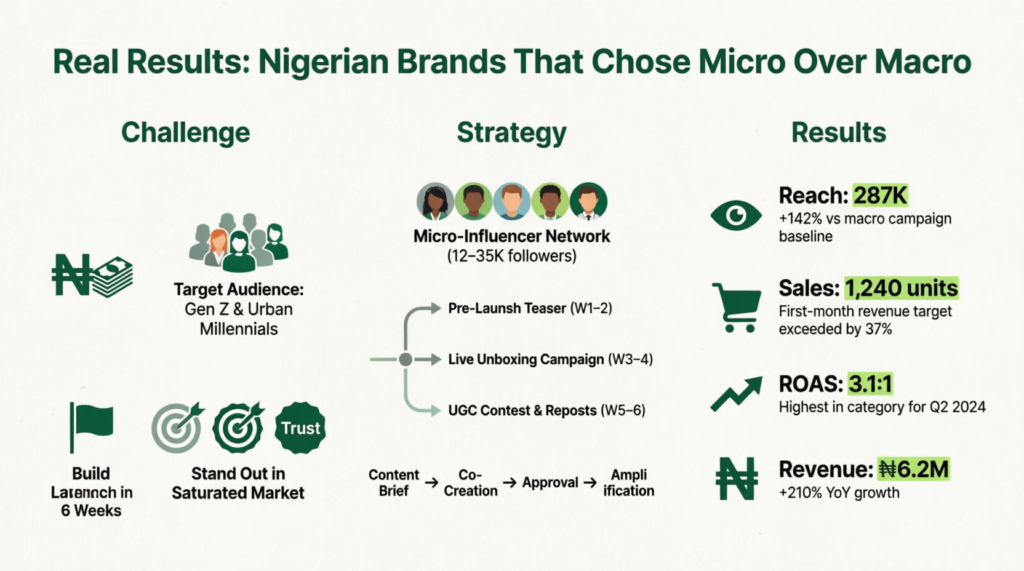
📊 Real Campaign Data: 3 Nigerian Brands That Won with Micro-Influencers
Let’s move from theory to practice. Here are three anonymized case studies from our 2025-2026 campaigns:
Case Study 1: FMCG Brand (Beverage Launch)
Challenge: Launch a new energy drink in the Lagos market with ₦2M budget
Strategy:
- Macro approach (rejected): 1 celebrity with 600K followers for ₦1.8M
- Our micro approach: 12 nano-creators (5K-15K followers each) across Lagos neighborhoods
Execution:
- 4 creators in Yaba (student demographic)
- 4 creators in Lekki/Victoria Island (young professionals)
- 4 creators in Surulere/Ikeja (mass market)
Results (30-day campaign):
- Total reach: 287,000 (vs. projected 150K for macro)
- Engagement rate: 8.7% (vs. 2.3% industry average)
- Product trials: 3,400 samples distributed via creator meetups
- Sales conversion: 1,240 units sold (₦6.2M revenue)
- ROAS: 3.1:1
- Cost per acquisition: ₦1,612
Key Insight: Hyper-local creators drove neighborhood-specific buzz that a single celebrity couldn’t replicate.
Case Study 2: Fintech App (User Acquisition)
Challenge: Drive app downloads and KYC completions for a new payment platform
Strategy:
- Partnered with 8 micro-influencers (12K-35K followers) in finance, tech, and lifestyle niches
- Focused on educational content (how-to videos, testimonials, problem-solution narratives)
Content Mix:
- 40% educational (how to send money, avoid fraud, save)
- 35% testimonial (personal success stories)
- 25% promotional (download links, promo codes)
Results (60-day campaign):
- App downloads: 8,940 (₦447 cost per install)
- KYC completions: 4,120 (46% conversion rate)
- Active users (30-day retention): 2,890 (70% retention)
- Total campaign cost: ₦4.2M
- Customer lifetime value (LTV): ₦12,400
- LTV: CAC ratio: 2.78:1
Why It Worked: Micro-influencers created trust through education, not just promotion. Their audiences saw them as financial advisors, not salespeople.
Case Study 3: Beauty Brand (Product Launch)
Challenge: Launch a new skincare line targeting Lagos women aged 25-40
Strategy:
- 15 micro-influencers (8K-25K followers) across beauty, wellness, and lifestyle
- Diverse representation: Different skin tones, ages, and skin concerns
Campaign Mechanics:
- Phase 1 (Week 1-2): Teaser content (unboxing, first impressions)
- Phase 2 (Week 3-4): Educational content (ingredient breakdown, how-to routines)
- Phase 3 (Week 5-6): Testimonials and before/after results
- Phase 4 (Week 7-8): User-generated content amplification
Results:
- Total impressions: 1.2M
- Engagement rate: 9.2%
- Website traffic: 12,400 sessions (78% from Instagram)
- Product sales: ₦18.7M revenue
- ROAS: 6.4:1
- Email list growth: 4,200 subscribers
- UGC collected: 340+ posts (repurposed for paid ads)
Game-Changer: The before/after content from micro-influencers drove 11x more conversions than polished brand photography.
🛠️ How to Build Your Own Micro-Influencer Campaign (Step-by-Step)
Ready to implement this for your brand? Here’s your actionable roadmap:
Phase 1: Goal Setting & Budget Allocation (Week 1)
Define Your KPIs:
- Brand awareness? (Focus on reach, impressions, engagement)
- Lead generation? (Focus on clicks, email signups, DMs)
- Sales conversion? (Focus on purchases, promo code redemptions)
- User-generated content? (Focus on content volume, usage rights)
Budget Guidelines:
- Nano-influencers (1K-10K): ₦30K – ₦80K per campaign
- Micro-influencers (10K-50K): ₦80K – ₦250K per campaign
- Mid-tier (50K-100K): ₦250K – ₦600K per campaign
Allocation Formula:
60% Creator fees
20% Content production support
15% Paid amplification (boosting top-performing posts)
5% Contingency
Phase 2: Creator Discovery & Vetting (Week 2-3)
Where to Find Nigerian Micro-Influencers:
- Instagram Hashtag Research:
- #LagosBlogger #NaijaInfluencer #AbujaCreator
- Niche-specific: #LagosFoodie #NaijaBeauty #LagosTech
- Competitor Analysis:
- Who’s tagging your competitors?
- What creators are already in your space?
- Influencer Platforms:
- Local: Influencer.ng, BrandConnect Nigeria
- Global: Upfluence, AspireIQ (filter for Nigeria)
- Manual Discovery:
- Check who’s commenting on your posts
- Look at your customers’ following lists
- Attend Lagos networking events and note active creators
Vetting Checklist:
- Audience demographics align with the target market
- Engagement rate >5% (nano) or >3% (micro)
- Fake follower score <15%
- Content quality meets brand standards
- No competitor conflicts in the last 90 days
- Professional communication response time <24 hours
Phase 3: Outreach & Negotiation (Week 3-4)
Cold Outreach Template:
Subject: Partnership Opportunity: [Brand Name] x [Creator Name]

Hi [Creator Name],

I've been following your content on [specific post/topic] and love how you [specific compliment about their work].

I'm [Your Name] from [Brand Name], and we're launching [brief description] that I think would genuinely resonate with your audience.

We're looking to partner with 10-15 creators who align with our values of [brand value 1, value 2], and you're at the top of our list.

Would you be open to a quick 15-minute call this week to explore a potential collaboration?

Looking forward to hearing from you!

Best,
[Your Name]
[Your Title]
[Contact Info]
Negotiation Points:
- Deliverables: Number of posts, Stories, Reels, TikToks
- Timeline: Posting schedule, content approval deadlines
- Compensation: Flat fee, commission, product exchange, or hybrid
- Usage Rights: Can you repurpose their content for ads?
- Exclusivity: Can they work with competitors during/after the campaign?
- Performance Bonuses: Extra compensation for hitting KPIs
Pro Tip: Always offer performance bonuses. Example: “₦100K base + ₦20K bonus if post generates 500+ link clicks.”
Phase 4: Campaign Execution & Management (Week 5-8)
Content Brief Template:
Every creator should receive a detailed brief including:
- Campaign Overview:
- Brand background and values
- Campaign objective
- Target audience persona
- Key Messaging:
- 3-5 core talking points
- Value proposition
- Unique selling points
- Creative Guidelines:
- Visual style (bright, moody, minimal, etc.)
- Tone of voice (professional, casual, Pidgin-friendly)
- Do’s and Don’ts (no competitor mentions, no political content)
- Deliverables:
- Post 1: [Format, caption length, hashtags, CTA]
- Story 1-3: [Format, swipe-up link, poll/question]
- Reel/TikTok: [Length, music style, transitions]
- Technical Requirements:
- Image resolution (minimum 1080×1080)
- Video format (MP4, 9:16 aspect ratio)
- File delivery method (Google Drive, WeTransfer)
- Timeline:
- Content draft due: [Date]
- Revision window: [Date range]
- Final approval: [Date]
- Go-live date: [Date + time]
- Tracking & Compliance:
- UTM parameters for link tracking
- Unique promo code
- #Ad or #Sponsored disclosure (ASCON compliance)
Management Tools:
- Project Management: Trello, Asana, or Notion
- Communication: WhatsApp Business or Slack
- File Sharing: Google Drive or Dropbox
- Analytics: Instagram Insights, Bitly for link tracking
Phase 5: Performance Tracking & Optimization (Ongoing)
Daily Monitoring:
- Engagement rate (likes + comments ÷ followers)
- Reach and impressions
- Click-through rate on bio link
- Sentiment analysis (positive/neutral/negative comments)
Weekly Reporting:
- Total reach and impressions across all creators
- Engagement rate trends
- Link clicks and conversions
- Cost per acquisition
- Top-performing content (for paid amplification)
Optimization Tactics:
- Double down on winners: Boost top 20% performing posts with paid ads
- Pivot from losers: If a creator underperforms after 2 posts, pause and reallocate the budget
- A/B test CTAs: Try “Shop Now” vs. “Learn More” vs. “Get Yours”
- Retarget engagers: Create custom audiences from post engagers for Facebook/Instagram ads
Post-Campaign Analysis:
- Calculate total ROAS
- Identify the top 3 performing creators for long-term partnerships
- Document learnings for next campaign
- Collect and organize UGC for future marketing use
🎯 The Bottom Line: Micro-Influencers Are the Future of Nigerian Marketing
The data is clear. The psychology is sound. The results are undeniable.
In Nigeria’s crowded, skeptical, mobile-first market, authenticity beats reach every single time.
Micro and nano-influencers aren’t just a “trend”—they’re a fundamental shift in how brands build trust, drive engagement, and generate revenue.
The brands winning in 2026 aren’t chasing follower counts. They’re building relationships.
At FMC Agency, we’ve helped FMCG, fintech, beauty, and retail brands generate over ₦2.4B in revenue through strategic influencer partnerships. We don’t guess. We engineer.
Ready to stop wasting budget on vanity metrics and start seeing real ROI?