INTRODUCTION
Nigeria’s Most Powerful Marketing Tool
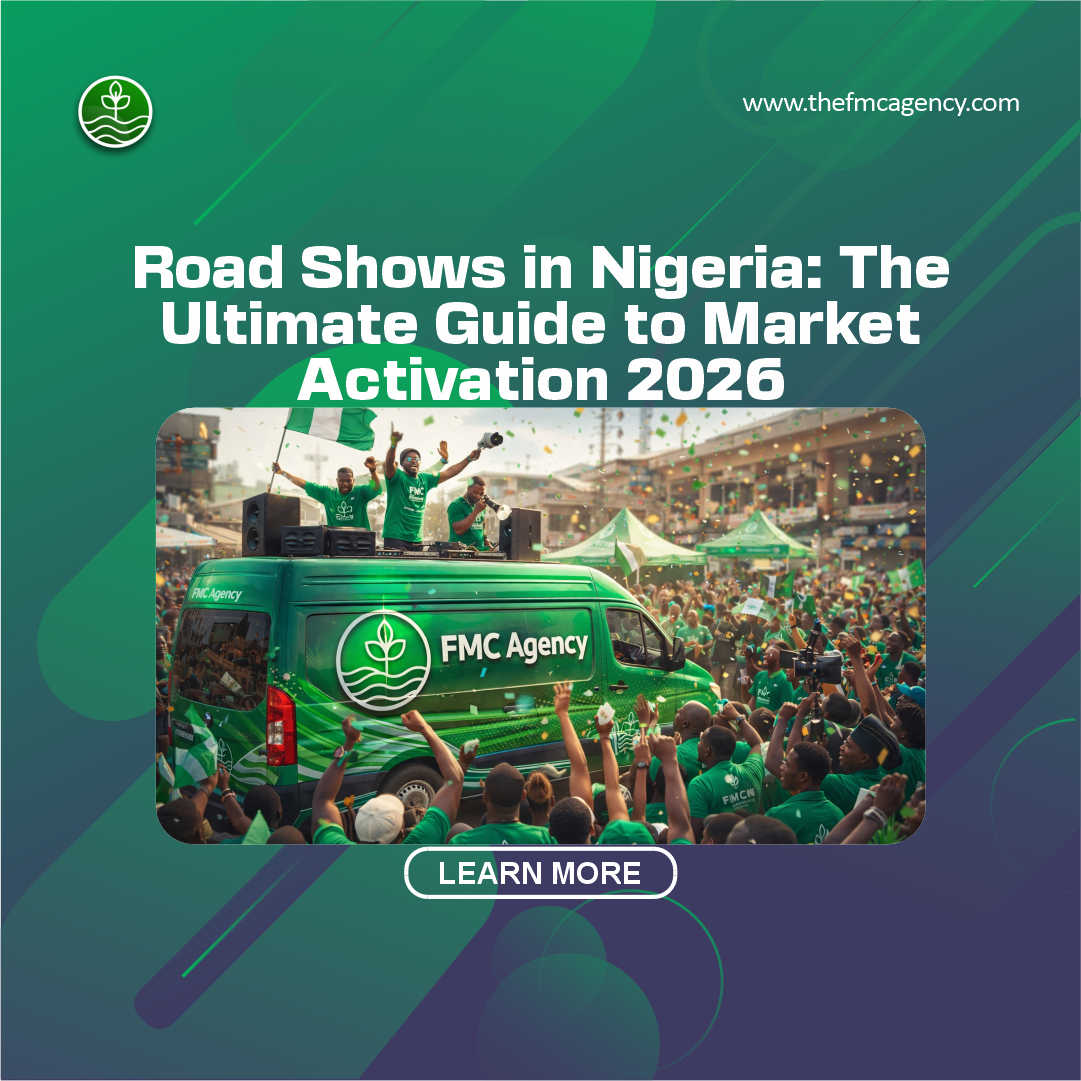
In a country of over 220 million people spread across diverse geographies, languages, and income brackets, road show marketing in Nigeria remains the single most effective way to bring a brand directly into the hands and hearts of everyday consumers.
Digital advertising has its place. But in Nigeria, trust is earned face-to-face. A well-executed road show lets your brand break through the noise, build instant credibility, and generate the kind of word-of-mouth that no paid campaign can replicate. From the bustling markets of Lagos Island to the commercial corridors of Onitsha and Kano, road shows put your product where people actually live and shop.
The psychology behind in-person brand interaction is simple but profound: when a consumer physically holds your product, tastes it, or sees it in action, the psychological barrier to purchase collapses. They are no longer guessing they know. That moment of knowing is what road shows are designed to create at scale.
| Pro Tip: Nigerian consumers who experience a product in-person are up to 4x more likely to purchase it than those who only see it advertised digitally. Road shows are not just marketing; they are accelerated sales. |
This guide covers everything: from defining what a road show actually is to planning the perfect route through Lagos, calculating your budget, training your brand ambassadors, and measuring ROI with precision. Whether you are a startup launching a new FMCG product or an established brand refreshing its presence in the market, this guide is your roadmap.
SECTION 1
What Is a Road Show?
A road show (also written as roadshow) is a mobile brand activation campaign in which a company brings its marketing effort directly to the consumer, rather than waiting for consumers to come to the brand. It is the cornerstone of BTL (Below-The-Line) marketing in Nigeria and across Africa.
Types of Road Shows in Nigeria
- Mobile Van Activations: A branded vehicle, truck, bus, or van moves across multiple locations, creating a mini pop-up experience at each stop.
- Trade Road Shows: Targeting retailers, distributors, and trade partners; common in FMCG and pharma sectors.
- Consumer Sampling Tours: Free product samples are distributed at high-traffic locations, such as markets, schools, and transport hubs.
- Experiential Road Shows: Interactive booths with games, demos, and digital touchpoints designed to create an unforgettable brand memory.
- Investor Road Shows: Companies present business pitches to investors across multiple cities.
Road Show vs. Other Activation Types
| Activation Type | Mobility | Cost Efficiency | Consumer Reach |
| Road Show | High (multi-location) | ★★★★ | ★★★★★ |
| Static Brand Booth | Low (fixed) | ★★★ | ★★★ |
| Event Sponsorship | Medium | ★★ | ★★★★ |
| In-Store Promo | Low | ★★★★★ | ★★ |
| Digital Campaign | Virtual | ★★★ | ★★★★ |
A successful road show combines three core elements: a compelling brand experience, strategic location selection, and a trained human team that becomes the living face of your brand.
SECTION 2
Why Road Shows Work in Nigeria
Nigeria’s consumer market is unlike any other in Africa. With a median age of 18 years, over 60% of the population living below N200,000 per month, and internet penetration still evolving in many states, physical brand activation remains the most reliable path to consumer trust.
| 74%Of Nigerian consumers prefer to try before they buy | 4x higher purchase rate after in-person product sampling | 60%of new product discoveries happen via word-of-mouth | 82%of consumers trust brands they’ve experienced physically |
The Trust Factor
In Nigerian consumer culture, the need to see, touch, and verify before committing is deeply ingrained. This isn’t a barrier, it’s an opportunity. A road show activation that puts your product directly in a consumer’s hand at their local market or motor park does in 30 seconds what three months of billboard advertising cannot.
Sampling Effectiveness in Nigeria
Free samples work everywhere in the world. But in Nigeria, they work with a multiplier effect. When a consumer receives a free product, they don’t just try it, they talk about it. A study of FMCG road show campaigns in Lagos showed that every 10 samples distributed generated an average of 6.4 additional conversations about the brand within the consumer’s social circle, which marketers call earned word-of-mouth amplification.
| “The most effective marketing in Nigeria still happens between people on the street, at the bus stop, in the market. A road show is how you start that conversation.” |
Social Proof at Scale
When Nigerians see a crowd forming around a branded activation, they gather. Curiosity is powerful. A well-designed road show uses this to its advantage, creating spectacle, energy, and visible excitement that draws in passersby organically. Before your brand ambassadors say a word, the crowd itself becomes the endorsement.
SECTION 3
Planning Your Road Show
Great road shows are never improvised. Every viral activation moment you have witnessed was the result of weeks of meticulous planning. Here is a step-by-step breakdown of how to plan a winning road show campaign in Nigeria.
| Define Your Objectives | |
|---|---|
| 1 | Before booking a vehicle or hiring staff, define what success looks like. Are you driving brand awareness (reach, impressions) or direct sales (units moved, leads captured)? These objectives will determine your location choices, staffing ratio, and the activities you run. Brand awareness: focus on high-footfall, high-visibility areas. Sales activation: target markets, trade areas, and neighborhoods with your core demographic. New product launch: combine sampling + engagement + data capture. Set SMART KPIs before Day 1 samples distributed, leads captured, social impressions |
| Route Planning | |
|---|---|
| 2 | High-Traffic Locations in Lagos & Beyond. The right location is everything. In Lagos alone, the following zones are proven road show hotspots. For pan-Nigeria activations, add Abuja (Wuse Market, Area 1), Port Harcourt (Rumuola), Kano (Kofar Wambai), and Onitsha (Main Market). Timing matters: Morning (7–10 am) and evening (4–7 pm) on weekdays see the highest pedestrian traffic. Saturdays are peak days in most markets. Ojuelegba / Surulere: High transit traffic, working-class demographic, excellent sampling volume. Ikeja Along / Computer Village: Youth market, tech-savvy consumers, strong social sharing. Balogun Market / Lagos Island: Traders, bulk buyers, word-of-mouth epicenter. Lekki / Ajah: Middle-to-upper income, brand-conscious consumers. Oshodi: Highest raw footfall in Lagos, massive volume, requires excellent crowd management |
| Budget Planning | |
|---|---|
| 3 | One of the most common reasons road shows underperform is poor budgeting. See the detailed breakdown below for a realistic 5-day Lagos activation (2026 figures). |
| Budget Line Item | Estimated Cost (₦) | Notes |
| Vehicle branding (van/truck wrap) | N350,000 – N800,000 | One-off cost; reusable |
| Vehicle hire / fuel (5 days) | N200,000 – N400,000 | Includes driver |
| Brand ambassadors (6/day x 5 days) | N300,000 – N600,000 | N10,000-N20,000/person/day |
| Supervisor / Team Lead | N100,000 – N180,000 | 5 days |
| Product samples | N200,000 – N1,000,000 | Varies by product value |
| Booth materials & props | N150,000 – N350,000 | Canopy, tables, displays |
| Permits & local government levies | N50,000 – N550,000 | Per LGA; essential |
| Security | N80,000 – N200,000 | 2 guards per day recommended |
| Photography / video documentation | N80,000 – N200,000 | Essential for post-reporting |
| Data capture tools (tablets/forms) | N30,000 – N80,000 | One-time setup |
| TOTAL ESTIMATED BUDGET | N1.5M – N4M | 5-day Lagos activation |
| Your physical setup is the first thing consumers see. It must communicate your brand instantly and invite interaction. Booth setup: Branded canopy, banner stands, product display table, giveaway stationEngagement activities: Games (spin-the-wheel, trivia), demos, taste tests, photo momentsData capture: Registration forms, QR codes to landing pages, WhatsApp opt-inSocial media integration: Branded hashtag, Instagram-worthy backdrop, in-field content capture | |
|---|---|
| 4 | Your physical setup is the first thing consumers see. It must communicate your brand instantly and invite interaction. Booth setup: Branded canopy, banner stands, product display table, giveaway station. Engagement activities: Games (spin-the-wheel, trivia), demos, taste tests, photo moments. Data capture: Registration forms, QR codes to landing pages, WhatsApp opt-in. Social media integration: Branded hashtag, Instagram-worthy backdrop, in-field content capture |
SECTION 4
Execution Best Practices
The gap between a good road show and a great one is almost always execution. You can have the perfect route, a stunning booth, and excellent products, and still fail if your team is not trained, your reporting is weak, or your crowd management breaks down.
Staff Training & Ambassador Briefing
Your brand ambassadors are your brand in human form. They must be trained not just briefed on the product, the talking points, how to handle objections, and how to behave when things go wrong. Conduct a mandatory pre-activation training (minimum 3 hours) covering:
- Product knowledge features, benefits, and usage instructions
- Brand voice and messaging dos and don’ts
- Approach techniques for initiating consumer interaction
- Handling skepticism and questions gracefully
- Grooming, uniform, and punctuality standards
- Crowd management signals and escalation procedures
- On-site reporting tools and how to use them
| Pro Tip: Golden Rule: A consumer’s opinion of your brand ambassador IS their opinion of your brand. Invest in your people; their energy, appearance, and knowledge are your most visible marketing assets on the ground. |
Crowd Management & Safety
Large-scale sampling activations in Nigerian markets can attract hundreds of people very quickly. Plan for this. Assign specific roles to team members: one person manages the queue, one distributes samples, one engages media, and one captures data. Have security present from the first hour. Never leave product unattended.
Real-Time Reporting
Modern road shows run on data. Use a simple daily reporting template or app that captures: number of samples distributed, consumer interactions, leads collected, media impressions, and any incidents. This data is essential not just for post-campaign analysis but for making real-time adjustments if Location A is underperforming by Day 2, move resources to Location B.
Photo & Video Documentation
Every road show should be treated as a content production opportunity. Assign a dedicated content person to capture high-quality photos and short videos throughout each day. This content serves multiple purposes: social media posting in real-time, post-campaign reporting to clients, and building a library of authentic brand imagery that money cannot otherwise buy.
SECTION 5
Measuring Road Show Success
What gets measured gets managed. Without a clear measurement framework, you will never know if your road show was worth the investment or how to make the next one better.
| Consumer Reach: Total unique individuals who interacted with your activation | Samples Distributed Units handed out vs. target efficiency indicator per location | Leads Captured, contact details, WhatsApp opt-ins, or form completions |
| Social Impressions: Organic posts, hashtag reach, and story mentions during the campaign | Social Impressions: Organic posts, hashtag reach, and story mentions during the campaign | Sell-Through Rate: Post-activation sales lift in covered locations vs. control areas |
ROI Calculation Formula
The simplest ROI formula for a road show: (Revenue Attributable to Campaign − Campaign Cost) ÷ Campaign Cost × 100. For brand awareness campaigns, use Cost Per Thousand Impressions (CPM) and compare it with your digital advertising benchmarks. In most Nigerian markets, a well-run road show delivers CPM that is 30–60% lower than equivalent digital reach.
Post-Activation Report
Within 72 hours of campaign completion, your agency should deliver a comprehensive report covering: daily performance by location, total reach and samples distributed, photo/video documentation, consumer feedback summaries, data capture results, and recommendations for the next activation.
SECTION 6
7 Common Road Show Mistakes to Avoid
After running hundreds of road show activations across Nigeria, FMC Agency has seen the same mistakes derail campaigns again and again. Here is what not to do and how to avoid it.
| ⚠ Mistake 1: No Permits or Approvals: Setting up in a location without local government or landlord approval is the fastest way to have your activation shut down within an hour. Always secure permits at least 5 business days in advance. |
| ⚠ Mistake 2: Untrained Brand Ambassadors: Staff who do not know the product or cannot answer basic questions destroy brand credibility on the spot. Training is non-negotiable, not optional. |
| ⚠ Mistake 3: Wrong Location Selection: High footfall does not always mean the right footfall. Activating in Balogun Market for a premium skincare brand targeting upwardly-mobile women is a mismatch. Know your consumer’s habitat. |
| ⚠ Mistake 4: No Real-Time Data Capture: If you are not capturing consumer data (name, phone number, area of residence), you are leaving the most valuable asset of a road show on the table. |
| ⚠ Mistake 5: Understaffing the Activation: A team of 3 people cannot manage a crowd of 100. Understaffing leads to chaotic distributions, poor consumer experience, and safety risks. Always have a minimum of 6 team members per activation point. |
| ⚠ Mistake 6: No Social Media Integration: Modern road shows are both offline and online events. Not capturing content for social media means half the potential reach is being ignored. |
| ⚠ Mistake 7: Choosing Price Over Quality: Hiring the cheapest agency often means the lowest quality staff, poor vehicle branding, and no reporting. In brand activation, a bad execution is worse than no execution. |
CONCLUSION + RESOURCES
Your Road Show Starts Here
Road show marketing in Nigeria is not just a tactic; it is a market reality. In a country where consumer trust is built through human connection, where word-of-mouth travels faster than any algorithm, and where physical presence signals brand commitment, the brands that invest in road shows are the brands that win.
Whether you are activating for the first time or looking to level up an existing BTL strategy, the framework in this guide gives you everything you need to plan, execute, and measure a world-class road show campaign across Nigeria.
Road Show Pre-Launch Checklist
- Objectives and KPIs defined and documented
- Locations selected and route map approved
- All local government and venue permits obtained
- Budget approved, and vendor contracts signed
- Vehicle branding completed and inspected
- Brand ambassadors recruited, trained, and uniformed
- Samples, materials, and booth props packed and confirmed
- Data capture system tested and ready
- Content creator briefed and equipment ready
- Real-time reporting template distributed to team leads
- Security arrangements confirmed
- Day 1 briefing call scheduled
| FMC Agency has executed 200+ road show campaigns across Lagos, Abuja, Port Harcourt, Kano and beyond. Let us build your next activation |